
An illustration imagining late October 1989, the day I landed in London. A damp cold that soaked into my bones, and a sky like several grey blankets layered on top of each other. Everything in this story begins here.
In 2025, I turned sixty-five and retired from the work I had done for most of my adult life.
Winters in Japan, the rest of the year in Britain. Once I settled into that rhythm, I finally had time to look back on the decades I had spent running. And I noticed something: my memories were losing their edges faster than I had expected.
The damp cold that soaked into my bones the day I landed. The first piece of sushi I shaped with shaking hands while being shouted at in a kitchen. The smell of a production line I walked alone, late at night, in an empty factory.
If I did nothing, all of it would eventually disappear without ever being told.
So I wrote it down. The result is "Sushi Business in Britain", a four-volume series published under the pen name Haruto Minami. All four volumes are now available, in both English and Japanese.
What the Story Is About
The protagonist is Ryo Fukasawa, a twenty-nine-year-old man.
He has just left medical school partway through his fifth year. He has no experience with Japanese cuisine whatsoever, and does not even know how to hold a knife properly. In late October 1989, he boards a plane for London alongside three skilled sushi chefs who speak almost no English. "We'll help each other out," one of them laughs. And so his life abroad begins.
What follows spans thirty-five years. From apprentice to factory manager. From factory manager to a consultant flying across Europe, the Middle East and Asia. And finally, to a small sushi school run with his wife.
I lived through the entire arc, from a time when Japanese food was an exotic curiosity in Britain, to a time when packaged sushi sits unremarkably on every supermarket shelf. This series is that arc, told as one man's story.
Volume One: The Apprentice in the City of Fog (1989-1997)
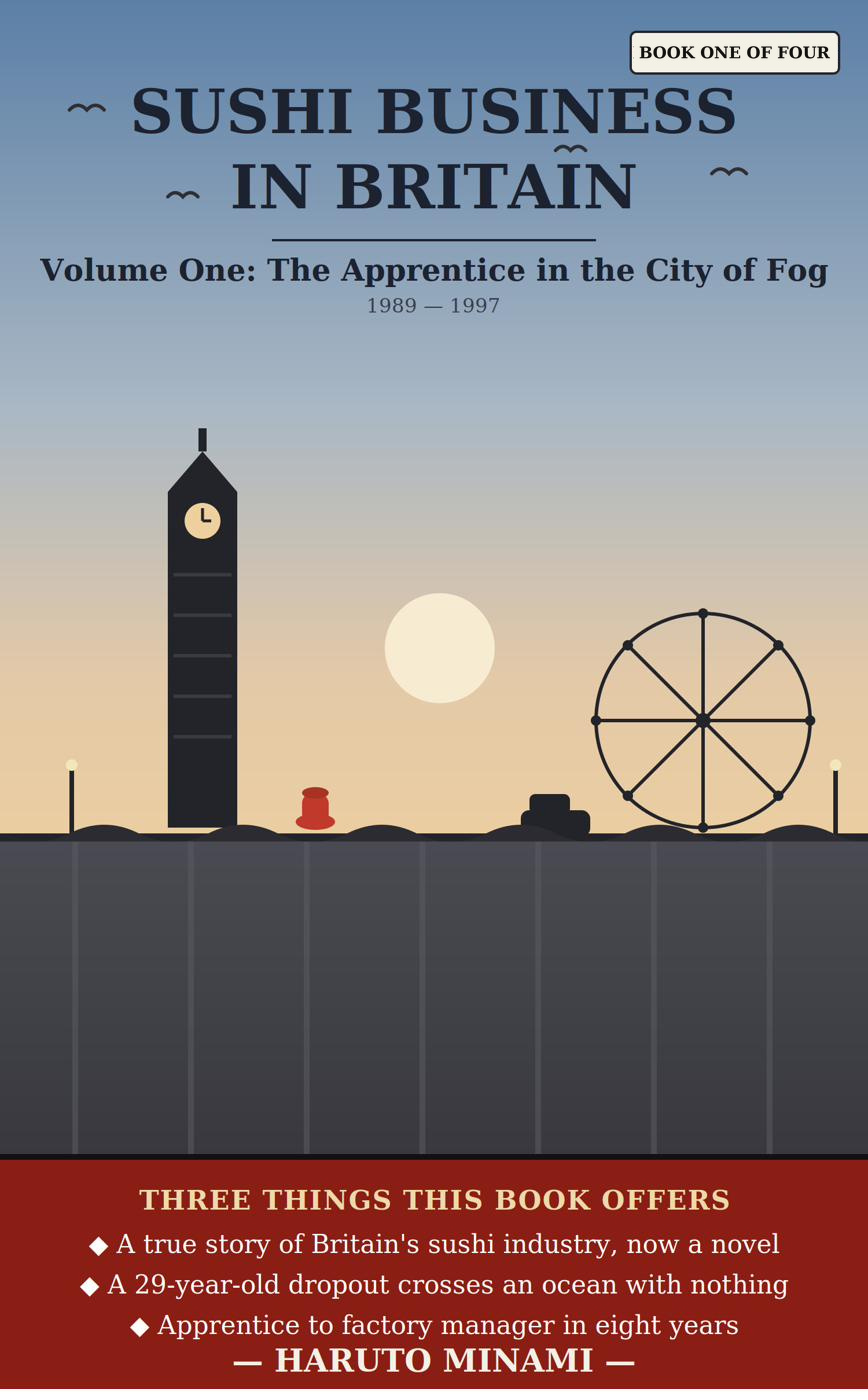
London in the final years of the Thatcher government. Mortgage rates had climbed past fifteen percent, and there was a tightness in the faces of people on the street. Being ordered out of an underground station because of a bomb scare was simply part of daily life.
Fukasawa throws himself into the kitchen of a small Japanese restaurant tucked into a corner of Piccadilly. Eight years of shouting, laughter, and slow transformation into a craftsman. Eventually the restaurant closes, and a new door opens with the launch of a Japanese shopping centre.
Volume Two: Building the Factory (1997-1999)
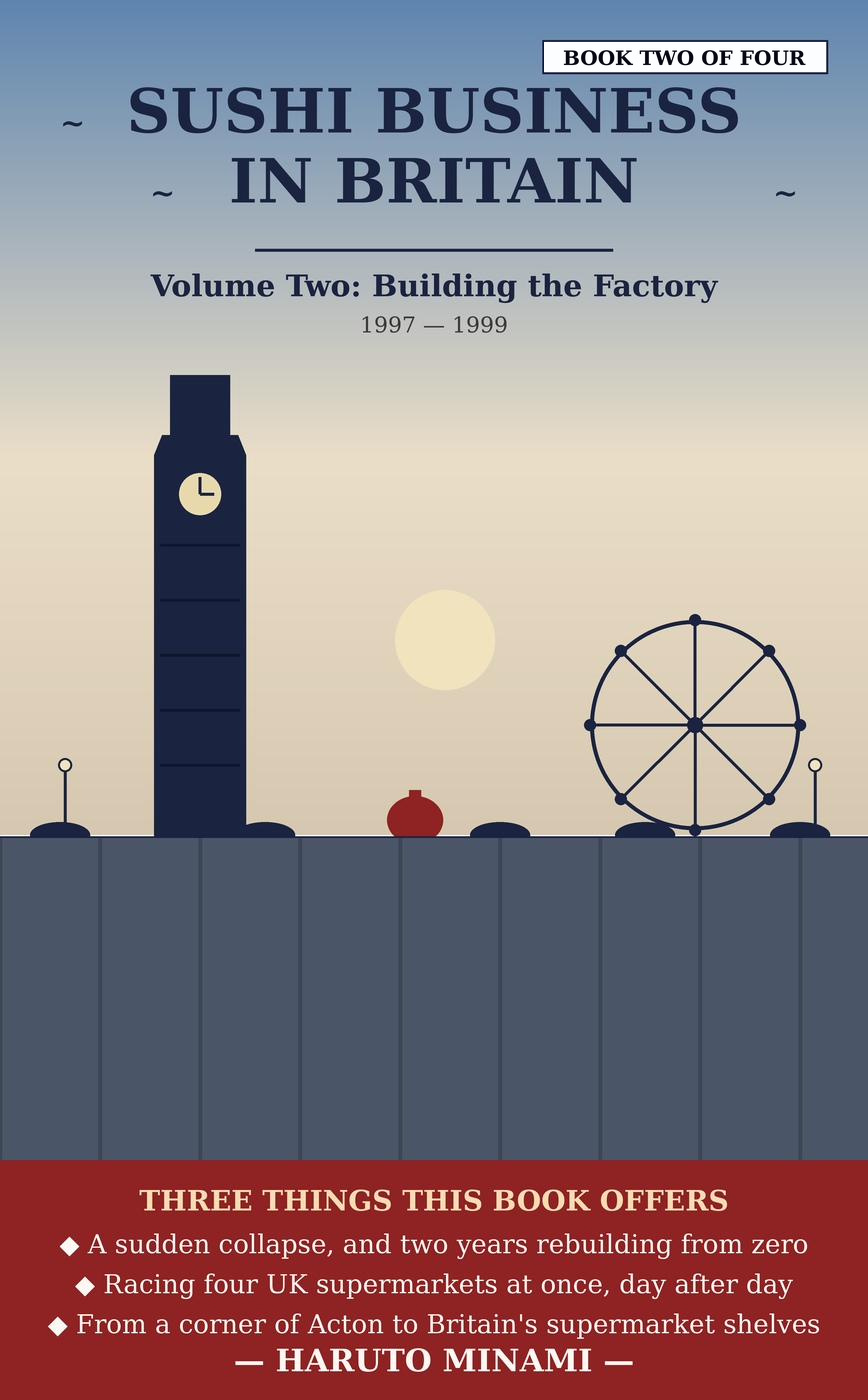
The sudden collapse of the parent company leaves a small sushi factory adrift. A meeting with a Japanese trading house gives it a second life in west London.
The target: ten thousand packs a day. Serving four major British supermarket chains simultaneously from a single factory, walking a tightrope every single day. Phone calls at midnight, night after night. There were nights when he stopped breathing in his sleep. Torn between work and family, an apprentice becomes a man who builds factories. Two years at full sprint.

An illustration of the sushi production line before dawn, the setting at the heart of this story. Ten thousand packs a day. I wrote this volume remembering the air on that floor, machine oil and vinegared rice mixed together, as I walked it alone at night.
Volume Three: The Sushi Missionary Who Crossed the World (1999-2018)
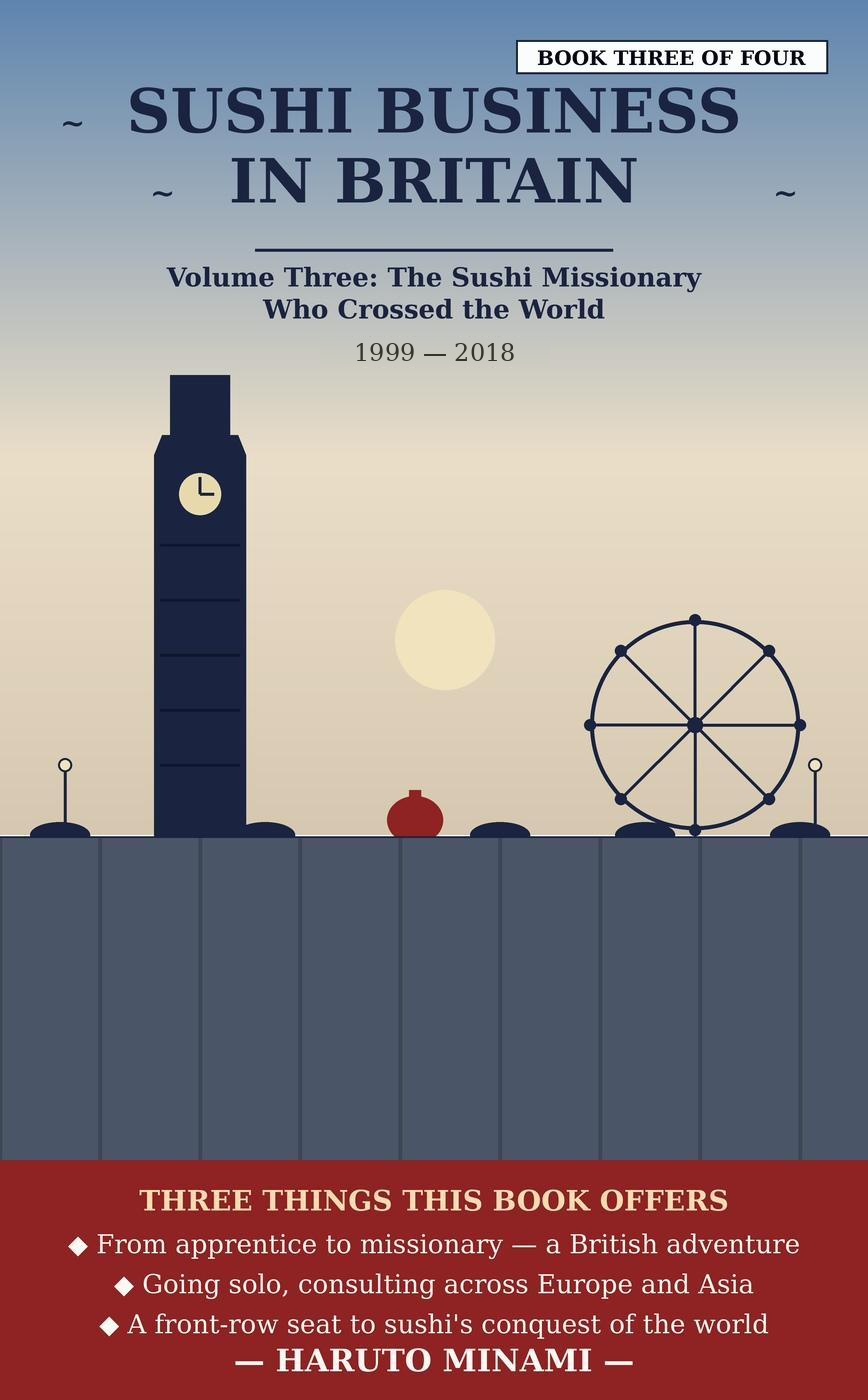
At thirty-nine, thinking that this might be the last year his body could handle striking out alone, Fukasawa goes independent.
Ireland, Iceland, France, Germany, Belgium, Austria, Denmark, Korea, Japan, and Israel. Twenty years of never quite finishing the unpacking. Facing clients who shared neither his language nor his food culture, the only weapon he had was a single craft, hammered into him on factory floors.
Chalkboard menus in a Loire bistro. A white beer standing at a Brussels station bar. The dry air of Jerusalem. And in the end, he watches the factory he once built pass through several owners before returning, improbably, to Japanese ownership. A long journey home.
Volume Four: One Who Teaches, A Heart That Conveys (2005-2026)
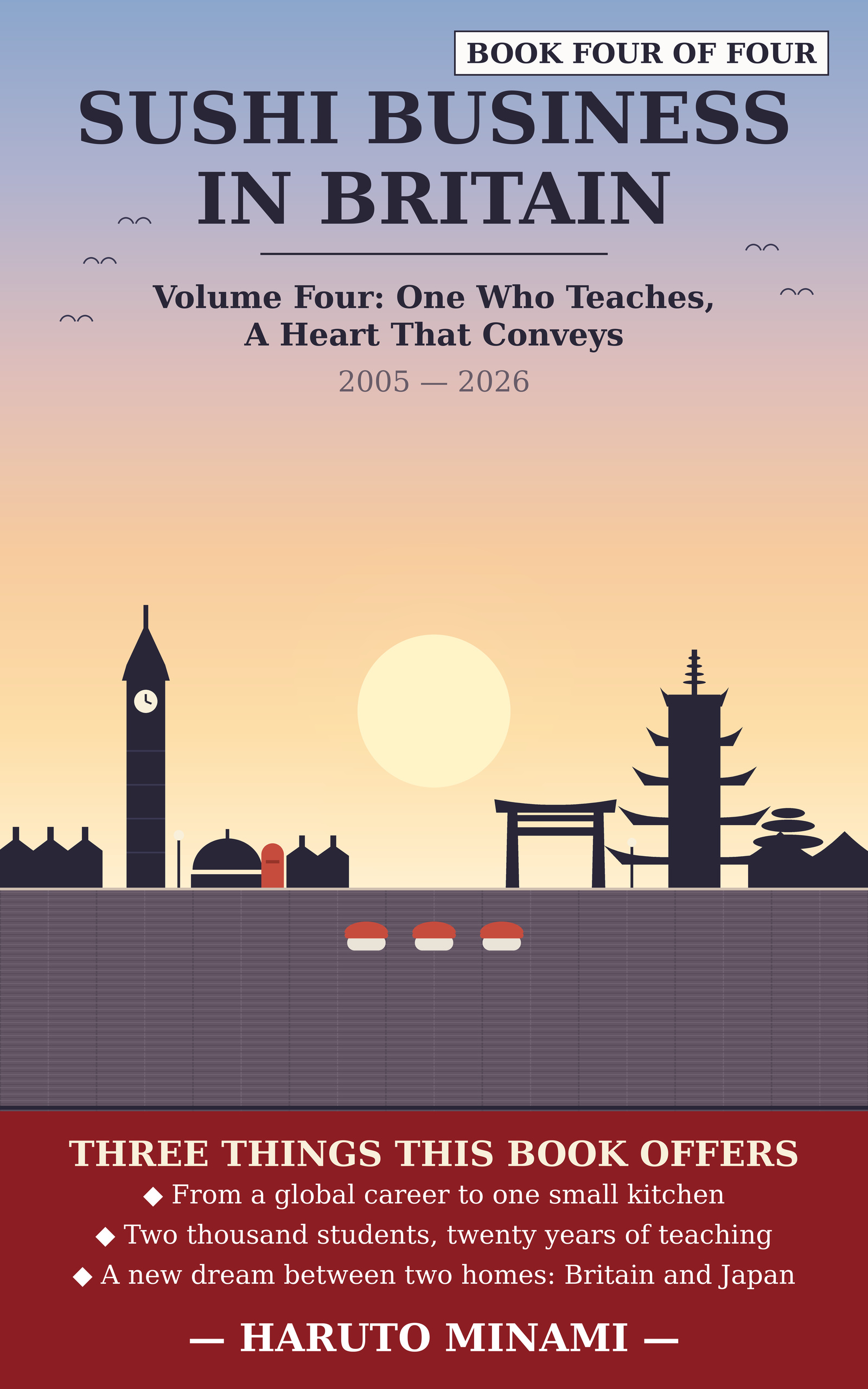
During the years when the world stopped moving, I stayed in one place for the first time in over three decades.
My wife had been quietly watching me teach through a screen. One evening she said something, and that remark became the beginning of a new chapter: a sushi school, run by the two of us.
A British head chef working aboard an oil prince's yacht. A Nordic couple who cook their way around the world on cruise ships. A private chef to an aristocratic family, learning sushi for a garden gathering. And a gentleman who handed over a bright red business card bearing nothing but the name of the British Parliament. Thirty-five years of memory, poured into one small kitchen.
Why I Chose Fiction
I will be honest: I originally planned to write a straightforward memoir.
But I realised almost immediately that there were things I could not write that way. People who helped me. People I caused trouble for. People still working in the industry today. Writing under real names would mean dragging their lives into my recollections without permission.
So every personal name in the series is invented. Every company name has been replaced, including real ones. Conversations and small details have been reshaped where the story needed it.
What I did keep faithful is the shape of events and the atmosphere of the times. Was the air really like that? Was that figure really correct? I questioned my own memory and rewrote, again and again.
This is a book about what was true, rather than a record of the facts.
The Era Itself Is Part of the Story

An illustration layering thirty-five years of change into a single frame. On the left, the London I arrived in; on the right, the London of today. It is hard to believe they are the same city.
Writing this series, what surprised me most was how profoundly Britain changed across those thirty-five years.
The end of Thatcherism. The giddy brightness that followed it. The vast observation wheel that appeared beside the river at the turn of the century. An island nation keeping its own currency while the continent embraced a single one. Then the departure from the European Union, and the years the world went still.
All of it is inseparable from the story of how sushi took root here. The spread of Japanese food was, in the end, also the story of a country changing.
Seen from the Japanese side, those same thirty-five years coincided almost exactly with the long draining away of the country's economic momentum. Japan's presence in the world grew fainter, and yet Japanese food kept steadily working its way onto tables everywhere. National strength and the spread of a food culture apparently run on different logic. That strangeness is one of the things I have felt most keenly across these decades.
A Note on How This Was Written
There is one more thing I want to be honest about.
I only began using generative artificial intelligence in 2026, and this manuscript was written alongside a conversational model.
I would scribble down memories as bullet points, and they would come back to me expanded into narrative. Then I would read what came back and correct it: no, the clouds were heavier that day; the factory did not smell like that. We repeated that exchange dozens, perhaps hundreds of times.
At my age, declining concentration and memory are, frankly, a real concern. On my own, I do not believe I could have finished four volumes.
If someone calls this a book written by a machine, perhaps that is fair. But what it felt like, from the inside, was having a patient companion who helped me dig up memories I had nearly lost. To anyone my age with something they want to leave behind, I would encourage you to try it.
Memory fades. But as long as the act of writing remains, a life can go on being edited. Having finished four volumes, that is the thing I now feel most certain about.
Who This Book Is For
- •Anyone curious about working and living abroad
- •Anyone interested in how Japanese food spread across the world, seen from the shop floor
- •Readers drawn to how British society changed from the 1990s onward
- •Anyone weighing a change of work in mid-life
- •And anyone who simply enjoys a story about a man who jumped into a foreign country with nothing
This is not a triumphant success story. The failures, the embarrassing misunderstandings, the moments that still make my face burn, I left them all in. I hope you will read it and laugh.
And if someone hesitating on the edge of their own step forward finds, somewhere in these four volumes, a moment of "ah, so there was someone like this too", that alone would make the writing worthwhile.
In Closing

An illustration of the passport I held for the first time at Narita in 1989. The blank visa pages looked like an empty résumé. Thirty-five years later, that blank space became four books.
In late October 1989, at Narita Airport, I held a passport for the first time in my life. I still remember thinking the blank visa pages looked like an empty résumé.
It never occurred to me that thirty-five years later, those blank pages would become four books.
If this series gives even a small push to someone standing at the edge of their own leap, nothing would make me happier.
Thank you for reading.
The Books Introduced Here
"Sushi Business in Britain" (by Haruto Minami) is available now in all four volumes. Each one is written to stand on its own, so you can begin anywhere.
English Editions
- Volume One: The Apprentice in the City of Fog £1.99 Buy on Amazon →
- Volume Two: Building the Factory £2.99 Buy on Amazon →
- Volume Three: The Sushi Missionary Who Crossed the World £3.99 Buy on Amazon →
- Volume Four: One Who Teaches, A Heart That Conveys £3.99 Buy on Amazon →
The original Japanese editions are also available.
Japanese Original Editions
- 霧の街の見習い 1989-1997 ¥399 Buy on Amazon →
- 工場を築く 1997-1999 ¥499 Buy on Amazon →
- 世界を駆けた寿司伝道師 1999-2018 ¥599 Buy on Amazon →
- 教える人、伝える心 2005-2026 ¥599 Buy on Amazon →
As an Amazon Associate I earn from qualifying purchases.